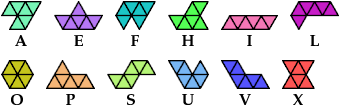
A hexiamond is a plane figure formed by joining 6 equilateral triangles edge to edge.
A trapezium is a quadrilateral with just two sides parallel. In the U.S. and Canada it is known as a trapezoid, because of a mixup in a popular 18th-century English dictionary of mathematics. For details, see this Wikipedia page.
A polyiamond with the shape of a trapezium is isosceles. That is, its two sides that are not parallel are equal.
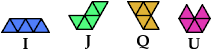
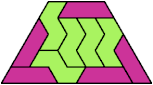
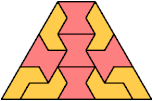
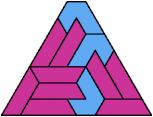
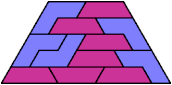
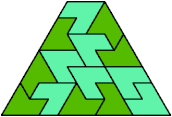
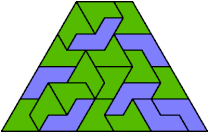
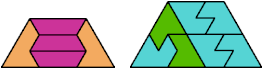
Here I show the smallest trapezium with full symmetry that can be tiled by a pentiamond and a hexiamond, using at least one copy of each. The solutions shown are not necessarily uniquely minimal. I admit triangles as a degenerate case of trapezia. If you find a smaller solution or solve an unsolved case, please write.
In the table, the figures indicate the numbers of polyiamond cells in the solutions.
| 6A | 6E | 6F | 6H | 6I | 6L | 6O | 6P | 6S | 6U | 6V | 6X | 5I | 16 | 144 | 33 | 64 | 11 | 32 | 51 | 16 | 55 | 63 | 65 | 21 | 5J | ? | ? | ? | ? | ? | ? | ? | 27 | ? | ? | ? | 60 | 5Q | 77 | ? | 16 | ? | 125 | 32 | 16 | 39 | ? | 16 | 112 | ? | 5U | ? | ? | ? | ? | ? | ? | ? | 32 | ? | ? | ? | ? |
|---|











Last revised 2026-08-10.