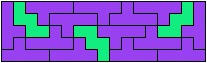
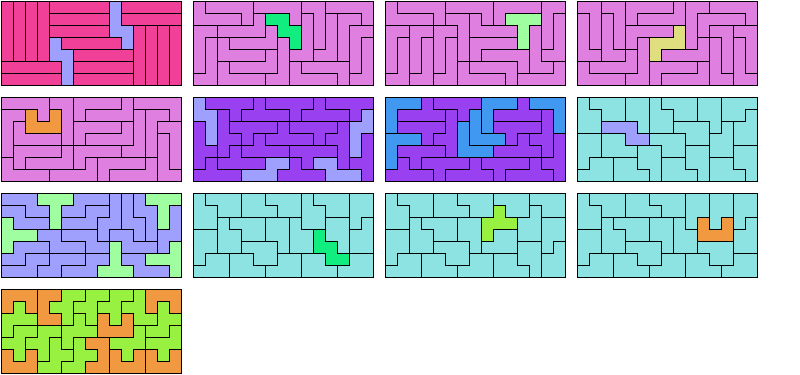
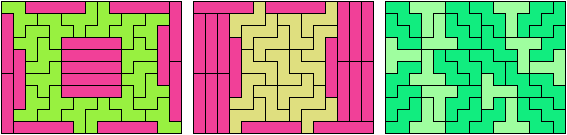
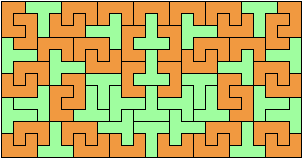
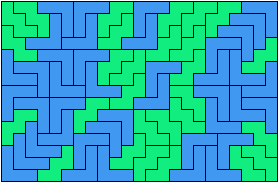
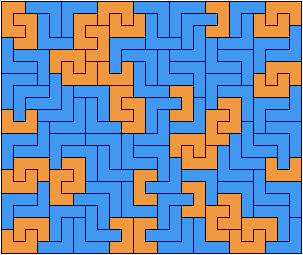
Here I impose the condition that an odd number of tiles must be used.
Earl S. Kramer was the first to study the problem of arranging copies of two pentominoes to form a rectangle. Mike Reid found sets of prime rectangles for all pairs of non-rectifiable pentominoes. They appear at Pairs of Pentominoes in Rectangles at Andrew Clarke's Poly Pages, and in the January 2001 issue of Math Magic.
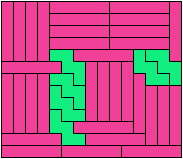
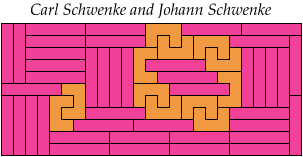
Carl Schwenke and Johann Schwenke improved one of my solutions.
| F | I | L | N | P | T | U | V | W | X | Y | Z | |
|---|---|---|---|---|---|---|---|---|---|---|---|---|
| F | * | 33 | 7 | × | 21 | × | 21 | 27 | × | × | 5 | × |
| I | 33 | * | 3 | 21 | 3 | 27 | 63 | 7 | 39 | × | 7 | 33 |
| L | 7 | 3 | * | 7 | 3 | 21 | 21 | 9 | 21 | 5 | 9 | 21 |
| N | × | 21 | 7 | * | 21 | 21 | 27 | 27 | × | × | 21 | × |
| P | 21 | 3 | 3 | 21 | * | 3 | 21 | 3 | 21 | 5 | 3 | 3 |
| T | × | 27 | 21 | 21 | 3 | * | 65 | × | 33 | × | 9 | × |
| U | 21 | 63 | 21 | 27 | 21 | 65 | * | 105 | × | 3 | 11 | × |
| V | 27 | 7 | 9 | 27 | 3 | × | 105 | * | 69 | × | 21 | 3 |
| W | × | 39 | 21 | × | 21 | 33 | × | 69 | * | × | 17 | × |
| X | × | × | 5 | × | 5 | × | 3 | × | × | * | 5 | × |
| Y | 5 | 7 | 9 | 21 | 3 | 9 | 11 | 21 | 17 | 5 | * | 5 |
| Z | × | 33 | 21 | × | 3 | × | × | 3 | × | × | 5 | * |






Last revised 2026-04-03.