Triquoin Oddities
Introduction
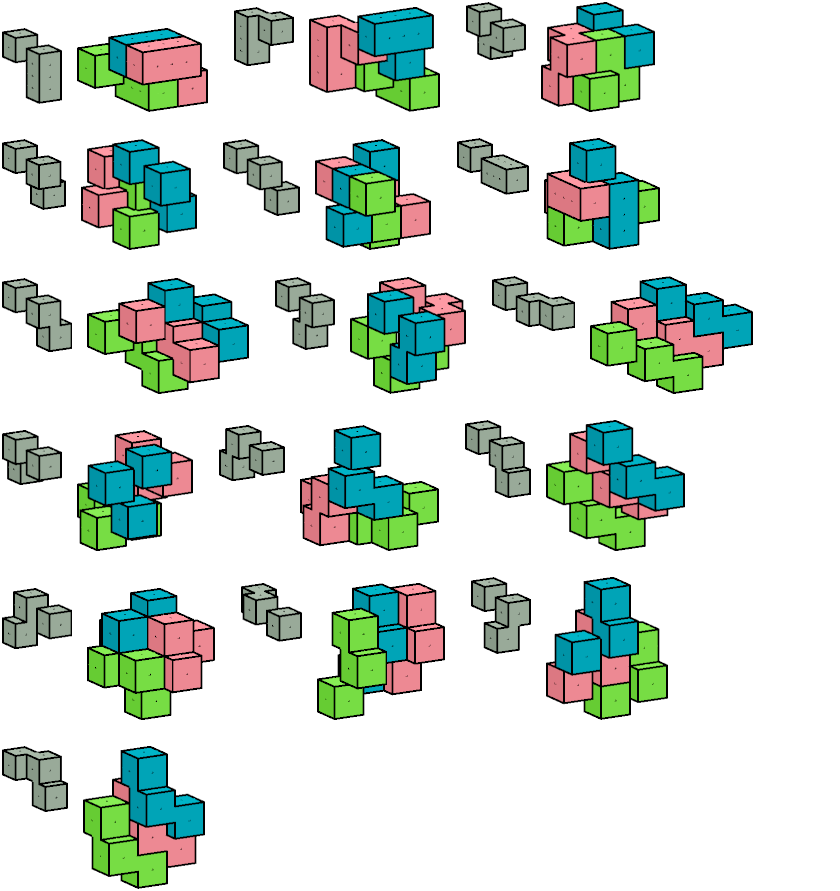
A triquoin is a solid made of three equal cubes joined
at faces, half faces, or quarter faces.
There are 35 triquoins, or 54 if mirror images are distinguished.
Triquoins were first defined and enumerated by John Mason.
See Catalogue of Polyquoins.
An oddity (or Sillke Figure)
is a figure with even symmetry
formed by an odd number of copies of a polyform.
Like polycubes, polyquoins have 33 symmetry classes (including asymmetry).
Of these classes, 31 have even order.
Here I use any convenient symmetry classes of even order.
With one exception, these oddities are known to be
minimal. Not all are uniquely so.
In constructing the oddities, the triquoins are not reflected.
This is customary when working with solid shapes.
If a triquoin has distinct mirror forms, only one appears here.
1 Tile
These 19 triquoins have even symmetry in their own right.
They are grouped by symmetry classes.
B6 (2): Orthogonal Rotation 180°
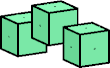
C4 (2): Plane Diagonal Rotation
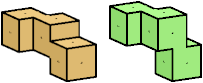
E4 (2): Orthogonal Reflection
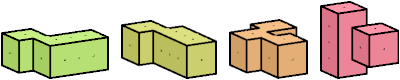
F5 (2): Diagonal Reflection
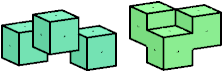
BE4 (4): Orthogonal Reflection and Rotation 180°
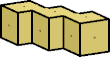
BF6 (4): Diagonal Reflection and Rotation 180°

CE3 (4): Orthogonal Reflection and Diagonal Reflection
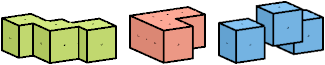
CK6 (4): Diagonal Reflection and Inverse (Point)
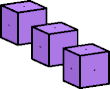
EE4 (4): Dual Orthogonal Reflection
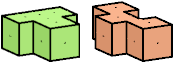
CD10 (6): Plane Diagonal Rotation and Solid Diagonal Rotation

BBC2 (16): Three-Way Orthogonal Reflection and Orthogonal Rotation

3 Tiles
Last revised 2026-02-22.
Back to Polyform Oddities
<
Polyform Curiosities
Col. George Sicherman
[ HOME
| MAIL
]